
Table of Contents
ToggleTraditional Chatbots vs Agentic AI
Introduction to AI-Driven Customer Support
Traditional chatbots vs agentic AI is quickly becoming a key topic in the evolution of customer support technology. While traditional chatbots helped businesses automate simple customer queries, modern agentic AI systems are capable of understanding problems, planning actions, and resolving customer issues automatically across multiple platforms.
Customer support has undergone a major transformation over the last decade. Businesses that once relied entirely on human agents answering calls and emails are now integrating artificial intelligence to manage large volumes of customer interactions.
Traditional Chatbots vs Agentic AI with the rapid growth of digital platforms, customers expect instant responses and quick problem resolution. Long wait times and delayed responses are no longer acceptable in a highly competitive digital marketplace.
Artificial intelligence began shaping customer service through automation tools like chatbots, which helped businesses respond to common queries faster. However, as customer expectations evolved, traditional chatbot technology began showing limitations in handling complex support requests.
Today, a new generation of intelligent systems known as Agentic AI is redefining how businesses manage customer support. Instead of simply answering questions, these systems can analyze problems, plan actions, and execute solutions automatically across multiple systems.
The Rise of Traditional Chatbots in Customer Service
Traditional chatbots became widely adopted as businesses looked for ways to automate repetitive customer service tasks. These bots were designed to simulate conversations with customers and provide quick responses to frequently asked questions.
They typically appear on websites, mobile applications, and messaging platforms, allowing customers to interact with businesses without needing immediate human assistance.
Organizations implemented chatbots to automate tasks such as:
- Answering common customer questions
- Providing order status updates
- Booking appointments or service requests
- Collecting customer information
- Routing complex issues to human agents
By handling routine queries, chatbots helped businesses reduce operational costs while providing faster response times.
Example of Traditional Chatbot Interaction
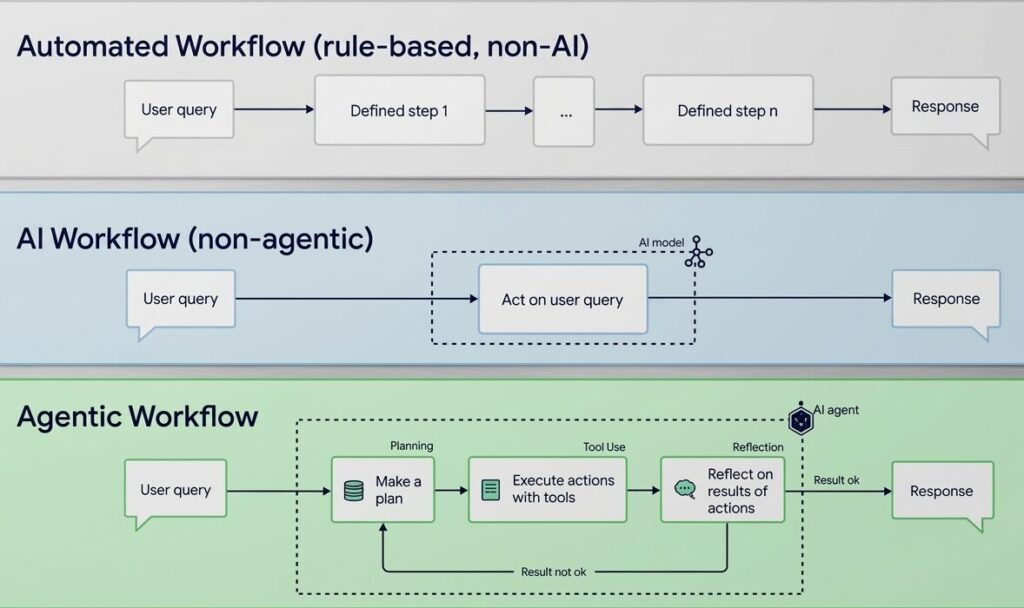

These systems are typically based on predefined rules, keyword recognition, or scripted conversational flows.
While this approach works well for simple questions, it often struggles when customers ask unexpected questions or require complex assistance.
How Traditional Chatbots Work
Traditional chatbots operate using rule-based logic or predefined workflows. When a user sends a message, the chatbot attempts to match the input with predefined responses.
The typical chatbot workflow follows these steps:
- User Query – A customer asks a question through chat or messaging platforms.
- Intent Detection – The chatbot identifies keywords or phrases in the query.
- Response Selection – The system chooses a predefined response from its database.
- Reply Delivery – The chatbot sends the response to the user.
- Escalation – If the bot cannot answer the question, it transfers the request to a human agent.
This system works effectively for predictable and repetitive queries, such as checking store hours or tracking orders.
However, modern customer service requires deeper problem solving and real-time decision making.
The Limitations of Traditional Chatbots
Although chatbots improved response speed and reduced workload for support teams, they have several limitations that affect the overall customer experience.
Limited Understanding
Most traditional chatbots rely on fixed conversation flows and cannot fully understand complex or ambiguous questions.
Lack of Context Awareness
Many bots cannot remember previous interactions or maintain conversation context across multiple messages.
Inability to Perform Actions
Traditional chatbots typically provide information rather than performing real operational tasks such as processing refunds or updating customer accounts.
High Escalation Rate
When a customer query falls outside the bot’s predefined logic, the conversation must be escalated to a human agent, increasing workload and response time.
These limitations have driven businesses to explore more advanced AI solutions capable of handling complex support scenarios.
What is Agentic AI in Customer Support?
Agentic AI represents the next evolution of artificial intelligence in customer service. Unlike traditional chatbots, agentic systems are designed to act autonomously to achieve specific goals.
Instead of simply responding to questions, agentic AI systems can:
- Understand customer intent
- Analyze complex problems
- Plan multiple steps to resolve an issue
- Access tools, APIs, and databases
- Execute tasks automatically
These systems function more like intelligent digital agents rather than scripted chat interfaces.
Example of Agentic AI Workflow


Agentic AI workflows combine reasoning, data access, and automation to solve problems end-to-end. In many cases, they can resolve customer issues without requiring human intervention.
How Agentic AI Works in Modern Support Systems
Agentic AI systems operate through structured workflows that combine several intelligent components working together.
A typical agentic customer support system includes:
Input Layer
Customer requests enter the system through channels such as chat, email, voice, or social messaging.
Intent Recognition
The AI system analyzes the request to understand the customer’s intent and identify the required action.
Context and Data Retrieval
The system retrieves relevant information such as customer history, order details, account status, or knowledge base articles.
Decision Planning
The AI agent determines the steps required to resolve the issue.
Task Execution
The system interacts with external tools and services to complete actions such as updating records, processing requests, or triggering workflows.
Response Delivery
Once the issue is resolved, the system provides the customer with a confirmation or solution.
This intelligent workflow allows agentic AI systems to manage more complex customer service scenarios than traditional chatbots.
Key Differences Between Traditional Chatbots and Agentic AI
|
Feature
|
Traditional Chatbots
|
Agentic AI
|
|---|---|---|
|
Function
|
Answer questions
|
Resolve problems
|
|
Intelligence
|
Rule-based responses
|
Autonomous reasoning
|
|
Task execution
|
Limited
|
Multi-step workflow execution
|
|
System integration
|
Minimal
|
Deep integration with business systems
|
|
Context awareness
|
Limited conversation memory
|
Continuous context understanding
|
|
Automation level
|
Reactive
|
Goal-driven and proactive
|
Traditional chatbots mainly focus on responding to customer questions.
Agentic AI systems, however, focus on completing tasks and solving customer problems automatically.
How Agentic AI Improves Customer Support Efficiency
Agentic AI significantly improves the performance of modern customer support operations by automating complex processes.
Faster Issue Resolution
AI agents can analyze customer requests and execute solutions instantly, reducing the time required to resolve support cases.
Reduced Support Workload
By handling repetitive and multi-step tasks automatically, AI systems allow human agents to focus on complex and high-value interactions.
Improved Customer Experience
Customers receive faster responses, accurate solutions, and consistent service across multiple channels.
Scalable Customer Support
AI-powered systems can manage thousands of customer interactions simultaneously without affecting service quality.
These improvements enable businesses to deliver high-quality support while maintaining operational efficiency.
The Future of Customer Support with Agentic AI
Customer expectations continue to evolve as digital experiences become faster and more personalized. Businesses must adapt their support strategies to meet these demands.
Agentic AI is expected to become a core component of modern customer support systems, enabling companies to automate complex workflows and provide proactive assistance.
In the future, AI-powered support platforms will not only answer questions but also anticipate customer needs, detect potential problems, and resolve issues before they escalate.
Organizations that adopt agentic AI technologies will be better positioned to deliver faster service, improve customer satisfaction, and scale their support operations effectively.
As artificial intelligence continues to advance, the shift from traditional chatbots to intelligent autonomous agents will define the next generation of customer support systems.