

Table of Contents
ToggleAI in Customer Support 2025: What’s the Current State?
As of 2025, AI is deeply embedded in modern support operations:
- Up to 95% of customer service interactions involve AI, though only 14–36% of cases are fully resolved autonomously today.
- Gartner projects that 80% of customer service organizations are exploring or piloting generative AI this year.
- AI tools reduce resolution times by as much as 52%, cut operational costs significantly, and lessen peak season staffing needs by up to 68%.
The current role of AI lays the foundation for the next wave of automation and intelligence.
How AI Evolved: From Chatbots to Agentic AI
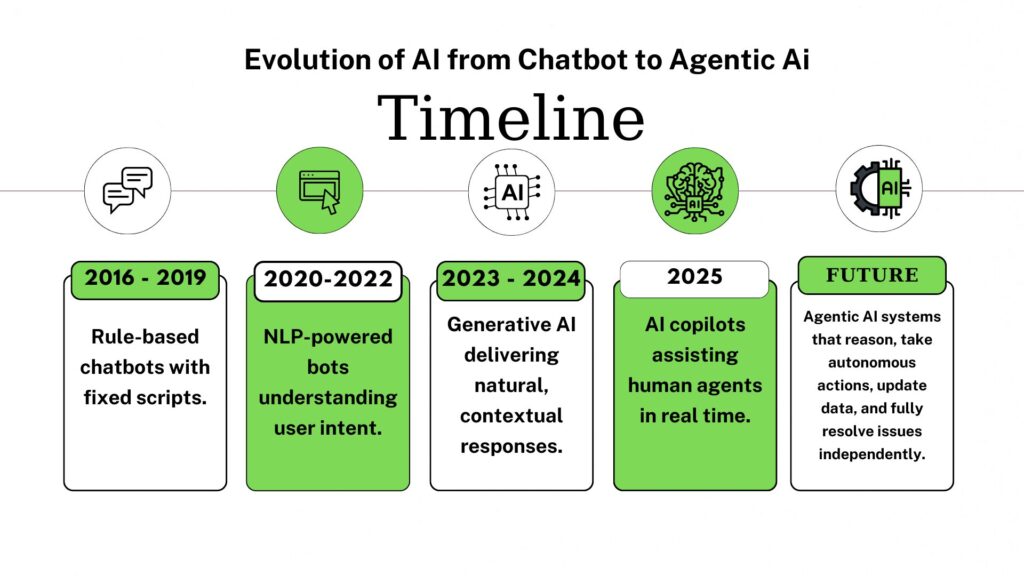
The AI chatbot evolution has moved through distinct stages:
- 2016–2019: Rule-based chatbots with fixed scripts.
- 2020–2022: NLP-powered bots understanding user intent.
- 2023–2024: Generative AI delivering natural, contextual responses.
- 2025: AI copilots assisting human agents in real time.
- 2026: Agentic AI systems that reason, take autonomous actions, update data, and fully resolve issues independently.
If you want to prepare your organisation for 2026 check out this blog -> Customer Support in 2026
According to Gartner’s 2025 prediction, agentic AI will autonomously resolve 80% of common customer issues without human intervention by 2029, driving a 30% reduction in operational costs.
" Agentic AI will autonomously resolve 80% of common customer issues without human intervention by 2029, driving a 30% reduction in operational costs."
Gartner's 2025 Report
Key Trends Shaping Customer Support Today

1. Emotion & Sentiment Intelligence
AI detects customer frustration, urgency, and sentiment, enabling more empathetic responses.
2. Hyper-Personalization
AI pulls from customer history and preferences to deliver tailored experiences.
3. Proactive Support
Predictive AI identifies issues like delivery delays or payment failures before customers raise them, with companies like Amazon leading these capabilities.
4. Omnichannel Memory
AI systems maintain context across WhatsApp, email, chat, and voice, eliminating repeated explanations and improving customer satisfaction.
The Changing Role of Human Support Agents

AI is evolving the customer support agent’s role rather than replacing it:
- Agents focus on complex, emotional, or high-value queries.
- AI copilots provide real-time suggestions, summaries, and compliance support.
- Teams increasingly need upskilling in AI supervision, escalation management, and ethical judgment.
- Humans become the quality-control and oversight layer, while AI acts as the first line of resolution.
Real-World AI Customer Support Use Cases & Verified Examples
Around the world, leading companies are already demonstrating how AI can elevate customer support from a reactive service to a proactive, intelligent function.
Take Airbnb, for example. The company uses generative AI behind the scenes to help its customer-service agents craft clear, consistent responses. Instead of spending time drafting emails manually, agents now rely on AI assistance that improves both speed and quality — ensuring guests receive accurate and friendly communication every time.
In India, HDFC Bank has transformed digital customer service with its popular EVA chatbot. Built in collaboration with Senseforth, EVA has handled millions of customer queries across web and mobile channels. From answering account questions to resolving common concerns instantly, EVA helps customers get answers in seconds, reducing the burden on human agents and simplifying banking experiences.
A similar shift can be seen at Amazon, where AI plays a crucial role in proactive customer support. Instead of waiting for customers to report delivery problems or delays, Amazon uses predictive AI models to detect potential issues in real time. This allows the company to notify customers early, offer solutions instantly, or initiate refunds automatically — often before the customer even realizes something went wrong.
These examples highlight a powerful truth: AI is no longer just a tool for automation. It is becoming an intelligent partner that anticipates needs, speeds up resolutions, and creates more human-friendly customer experiences.
What Businesses Must Do to Stay Ahead

To build a strong AI customer support strategy for 2025 and beyond, companies should:
- Invest in scalable agentic AI platforms with task automation and omnichannel intelligence.
- Establish strong governance around data privacy, model monitoring, human-in-the-loop escalation, and customer transparency.
- Train teams for human–AI collaboration, focusing on judgment, escalation, and AI oversight skills.
- Redesign workflows to be AI-first, with humans handling edge and high-empathy cases.
Ensure compliance with GDPR, RBI, and other regulations.
Challenges & Ethical Considerations
Privacy & Data Protection:
Ensure compliance with GDPR, RBI, and other regulations.
Transparency:
Customers must know when they are interacting with AI.
Bias & Fairness:
Continuous monitoring is essential to prevent discriminatory outcomes.
Human Oversights:
Human oversight remains crucial for fairness and accuracy.
Conclusion:
The next evolution of AI in customer support will be defined by autonomous resolution, real-time intelligence, and seamless human–AI collaboration. Companies that prepare today—by investing in agentic AI, strengthening governance, and training teams—will lead in 2026 and beyond.